If you are planning to buy acreage near Mandan, the land itself is only part of the decision. What looks simple on a map can get more complicated once you factor in utilities, driveway approval, septic placement, setbacks, and room for future buildings. The good news is that with the right planning, you can spot potential issues early and choose a parcel that works for the way you want to live. Let’s dive in.
Start With Parcel Eligibility
Before you fall in love with a rural property, make sure it is actually eligible for a home. Morton County says some parcels are non-conforming and may need to go through subdivision before a building permit can be issued. That means the first question is not just where you want to build, but whether the parcel is set up for residential use in the first place.
Financing can also affect your decision earlier than many buyers expect. Morton County notes that many lenders will not originate a mortgage on a property greater than 10 acres. If you need conventional financing, acreage size and legal lot status may shape what is realistic from the start.
A practical first step is reviewing the county Planning and Zoning GIS map. County staff says even a screenshot with aerial imagery turned on can help with early siting conversations before you pay for a survey. That can give you a useful first look at zoning, flood information, and planned road right-of-way widths.
Plan Utilities Before the House
One of the biggest acreage mistakes is choosing the house location first and trying to force utilities into the remaining space. In Morton County, that approach can create expensive or avoidable problems. County guidance recommends checking with utility companies before purchase and asking for a summary of extension costs, because service extensions often cost thousands of dollars.
Water Service Matters Early
If the parcel will rely on rural water, confirm service availability at the exact site. Missouri West Water describes three service areas in Morton County, including areas north of the Heart River, south of the Heart River, and western Morton County to the Stark County line. Since the system serves broad areas rather than every single parcel the same way, you will want to verify what connection or extension is needed for that specific property.
Septic Placement Comes First
For onsite wastewater systems, Western Plains Public Health issues septic permits for Morton County. Its permit worksheet is very clear that the site plan should show the house, current and future outbuildings, waterways, wells, and driveways. It also states that water source and wastewater treatment take priority over house location.
That is a major planning point for acreage buyers. If you want a house, shop, garage, and open yard, your septic area cannot be treated like leftover space. It needs to be part of the first draft of the layout.
Electric and Gas Service Can Vary
Morton County’s 2045 Comprehensive Plan says Mor-Gran-Sou serves most of Morton County, while Montana-Dakota Utilities serves the western portion and parts of greater Mandan. The same plan notes that remote sites may require significant electric-line extensions. In other words, two parcels with similar views or acreage may have very different utility costs.
Internet Is Location Specific
Telecom service in rural areas is location-dependent. County planning materials note that multiple providers serve rural households, but service should be confirmed at the exact parcel rather than assumed from the mailing address. If you work from home, stream often, or need dependable phone coverage, that check should happen before you commit.
Think About Access Early
Driveway access is more than a convenience issue. In unincorporated Morton County, an approved approach permit is required before a 911 address can be assigned. If you are outside city limits, that makes access approval one of the first boxes to check.
Morton County requires all new approaches, and improvements to existing approaches, to be approved by the Highway Department. The site visit considers sight distance, zoning regulations, county policy, and location. The county also says the number of approaches is limited to five per mile.
Road Type Changes the Process
If your parcel connects to a state road, approach permits must come from the Bismarck Division of the North Dakota Department of Transportation. The county also states that approach approval must come before a building permit, but approval alone does not satisfy zoning requirements or assign a 911 number. Each piece of the process matters, and none of them should be assumed.
Driveway Placement Affects Usability
The approach guide explains why driveway placement deserves careful thought. Road speed affects the needed slope, sight distance is a priority, and runoff cannot be directed onto the road where it may create winter icing. A driveway that works on paper may still be a poor fit in the field if visibility or drainage is weak.
For platted subdivision lots, Morton County allows one access approach per lot and requires access to interior subdivision roadways rather than exterior county roadways. If you are comparing raw acreage with a platted lot, that difference can affect how flexible the site feels.
Lay Out the Whole Site Together
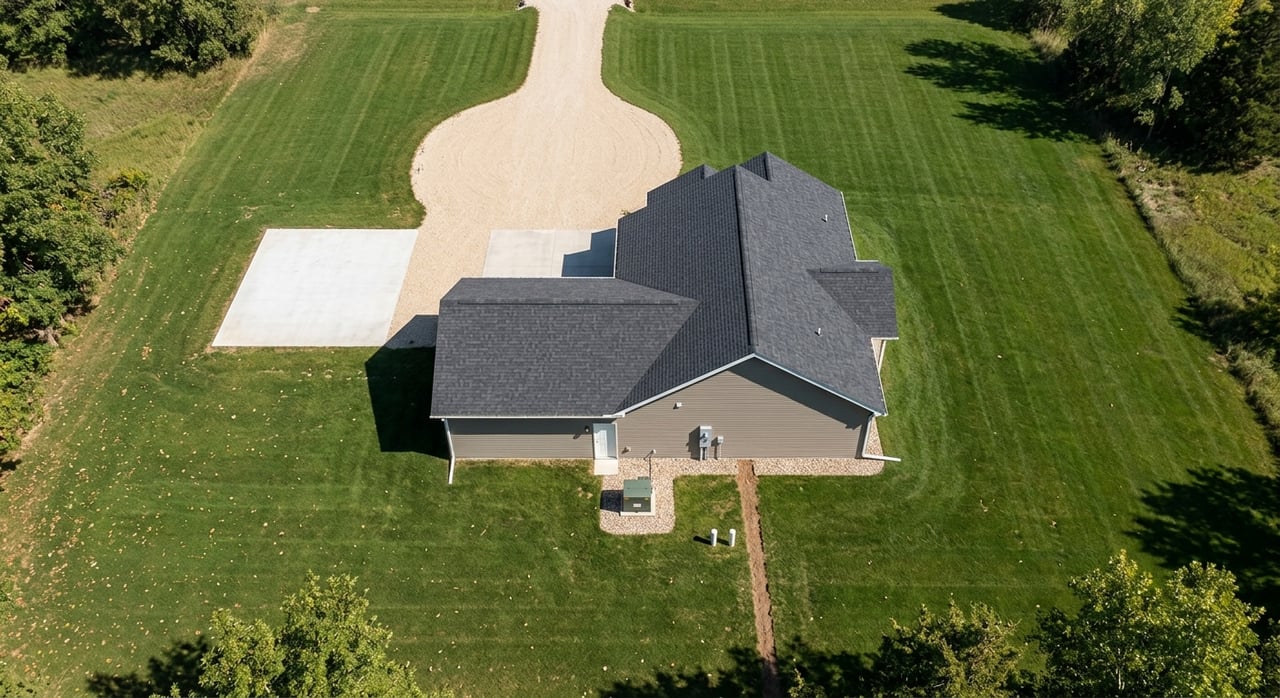
Once utilities and access are understood, the next step is building a site plan that treats the property as one connected system. Morton County’s building permit packet requires a layout showing the building footprint, distances to property lines, distances between buildings, the road centerline, utility lines, septic tank and drain field, easements, and a north arrow. That is a strong signal that the county expects the full plan to work together from the beginning.
Know the Setback Rules
For lots and tracts not served by public water and sanitary sewer, county code commonly uses front-yard setbacks of 40 to 60 feet, side-yard setbacks of 15 feet, and rear-yard setbacks of 20 to 50 feet, depending on zoning district. In some cases, accessory buildings may be as close as 10 feet from the rear property line. No accessory building may exceed two stories or 25 feet in height.
Those numbers are helpful, but they are not the whole story. The owner or contractor is responsible for meeting setback rules, and a survey is required if property lines cannot be established to the building inspector’s satisfaction. That means a rough idea of the corners is not always enough when it is time to build.
Roadway Setbacks Can Be Bigger
Roadway setbacks may be larger than the standard yard setbacks. Morton County lists minimum setbacks from the road centerline of 250 feet for interstates, 150 feet for arterials, 110 feet for rural collectors, 93 feet for section-line roads, and 80 feet for internal subdivision roads. On some parcels, road setbacks can shape the buildable area more than the side and rear lot lines do.
The Planning and Zoning GIS map can help here too because it includes planned right-of-way width for maintained roads. That gives you a better picture of how far improvements should stay back from the road and whether a future fence, driveway, or addition could conflict with county road space.
Save Space for Future Buildings
If you think you may want a shop, barn, or extra garage later, plan for it now. The septic permit worksheet asks you to show future outbuildings on the site plan, along with driveways, wells, waterways, and neighboring wells. That is a strong indication that future expansion should be part of the original layout, not an afterthought.
This is one area where smart early planning pays off. A site that preserves a clear driveway corridor, leaves room for a future shop, and keeps the septic reserve area open is usually easier to use and easier to explain later if you sell.
Watch for Floodplain and Terrain Issues
If the parcel is near a flood-prone area, Morton County advises reviewing access, terrain, and flood hazard areas early. The county building permit packet asks whether the property is in a flood plain and whether an elevation certificate is required. Even if the lot looks attractive from the road, the usable building area may be smaller than it first appears.
Terrain matters for day-to-day practicality as well. Slope can affect driveway design, drainage, septic placement, and winter access. Looking at aerial imagery and county mapping early can help you avoid a layout that becomes expensive once engineering and permits begin.
Why Good Layout Helps Resale
Acreage buyers often focus on today’s needs, but layout decisions can also affect long-term resale. A rural parcel is easier to understand when the access point, utility corridors, and septic area are already thought through. Buyers tend to feel more confident when there are fewer unknowns tied to permits and placement.
Morton County’s note about financing on parcels over 10 acres also matters here. A smaller, legally subdivided lot may appeal to a wider buyer pool if future buyers need conventional financing. Even if you plan to stay for years, flexibility can still add value.
A Simple Acreage Planning Checklist
Before you buy or finalize a homesite near Mandan, it helps to ask these questions:
- Is the parcel entitled for a residence, or does it need subdivision first?
- If financing is needed, will lot size create lending issues?
- Is an approach permit required, and has access been reviewed?
- If outside city limits, what is needed to receive a 911 address?
- What will water, electric, gas, and telecom service cost at this exact parcel?
- Where can the septic system and reserve area go?
- What setbacks apply from lot lines and the roadway centerline?
- Is there room for a future shop, barn, or detached garage?
- Are floodplain, terrain, or drainage issues likely to affect the site plan?
- Will a survey be needed before permit approval?
Acreage planning near Mandan is not just about picking the prettiest build spot. It is about making sure access, utilities, setbacks, and future use all work together on one clear plan. If you want help evaluating land, comparing sites, or thinking through how a parcel may function before you buy, Patrick Koski can help you approach the decision with practical local insight.
FAQs
Do I need driveway approval before getting a 911 address in rural Morton County?
- Yes. In unincorporated Morton County, an approved approach permit is required before a 911 address can be assigned.
Does septic planning affect house placement on acreage near Mandan?
- Yes. Western Plains Public Health states that water source and wastewater treatment take priority over house location.
Can I build a shop close to the back lot line in Morton County?
- Sometimes, but the exact setback depends on the zoning district and any roadway setback that also applies.
Do I always need a survey before building on acreage in Morton County?
- Not always. A survey is required if property lines cannot be established to the building inspector’s satisfaction.
Can utility costs vary from one acreage parcel to another near Mandan?
- Yes. County guidance notes that service extensions can cost thousands of dollars, and remote sites may require significant electric-line extensions.